Key takeaways in 3 minutes
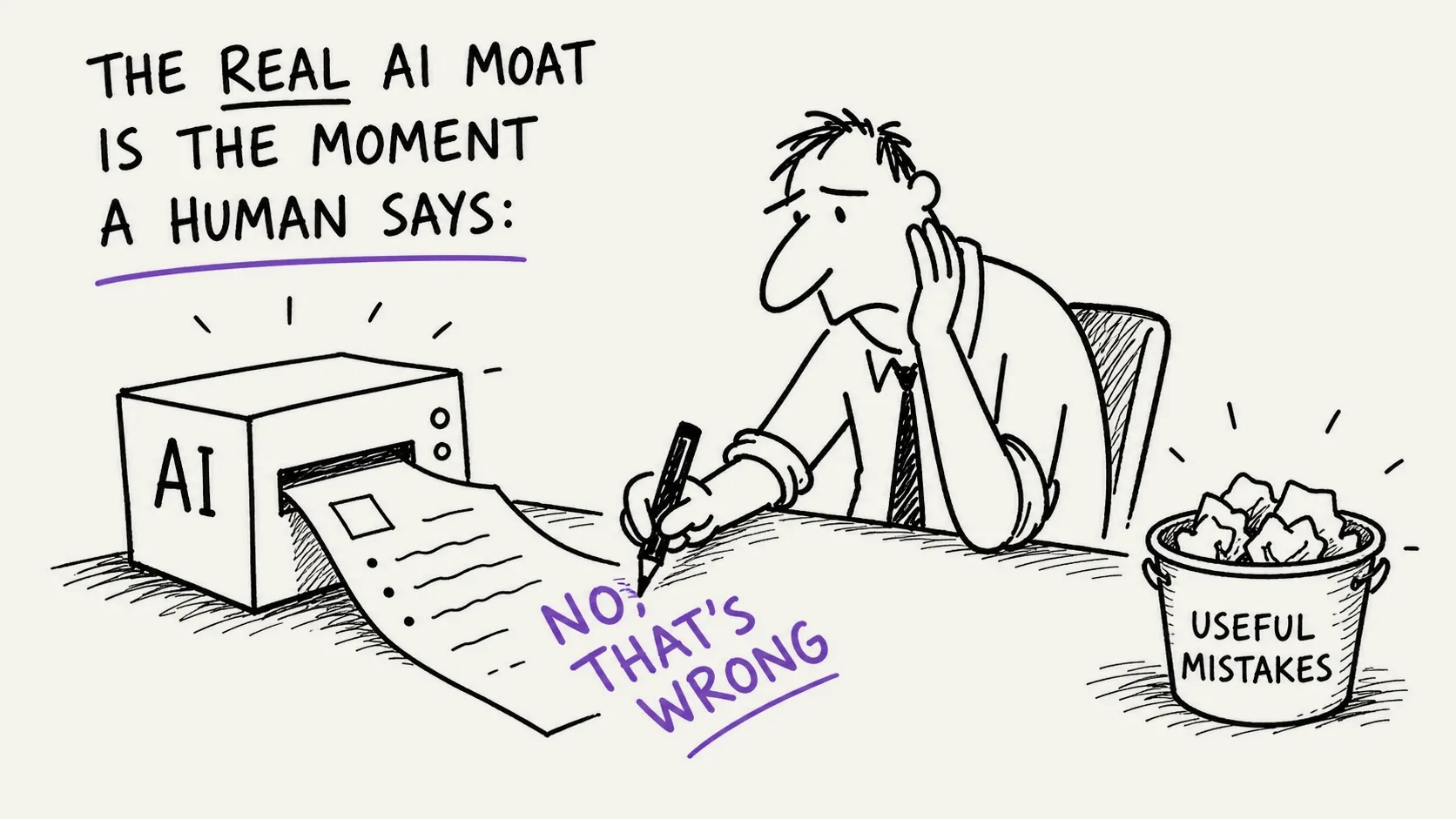
The most valuable signal in an AI product may be the moment a human says: "No, that's wrong."
The real AI moat is not the error. It is what the product does after the error.
The most valuable sentence in an AI product might be: "No, that's wrong."
In a well-designed product, correction is not just damage control. It is intelligence.
That sounds odd because we usually treat AI mistakes as failures to hide, apologise for, or smooth over with a nicer empty state. And yes, errors matter. If AI gets something important wrong, trust can vanish faster than a meeting agenda after the first tangent.
But in a well-designed product, correction is not just damage control. It is intelligence.
When a human corrects AI, they reveal what the system did not understand: a domain rule, an edge case, a policy constraint, a preference, a priority, a missing source, or a business judgement that was never written down properly.
Most products waste that signal.
Correction Is Not Just Friction
Many AI interfaces let users fix the immediate output. Edit the text. Change the classification. Override the recommendation. Move the ticket. Correct the extracted field.
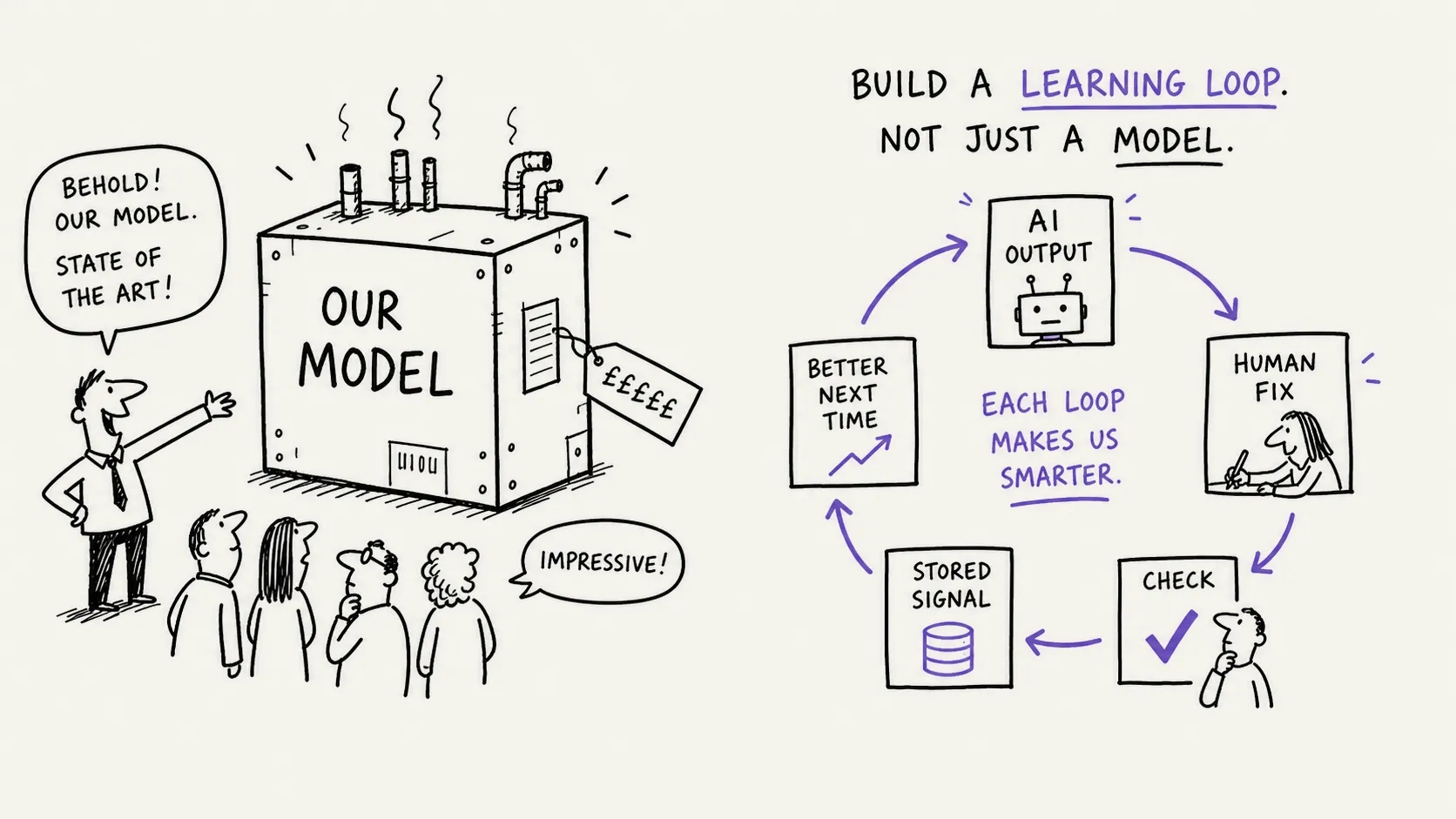
That helps the user finish the task, but it does not necessarily help the product improve. If the system makes the same mistake next Tuesday, the user is not giving feedback anymore. They are paying off product debt with their own time.
The better question is: what should the product learn from this correction?
That does not mean every edit should become a rule. Some corrections are one-offs. Some are taste. Some are context-specific. Some are the user changing their mind, which is deeply human and deeply inconvenient.
But many corrections are reusable signals. They should not disappear into the void.
What Corrections Reveal
A correction can reveal several kinds of product intelligence.
It can be factual: this supplier name is wrong, this date is missing, this total does not match.
It can be classificatory: this is not a support bug, it is a billing issue. This claim is not low risk, it needs review.
It can be policy-based: this clause breaches a rule, this approval route is not allowed, this customer segment requires a different process.
It can be about tone, priority, routing, formatting, evidence or confidence.
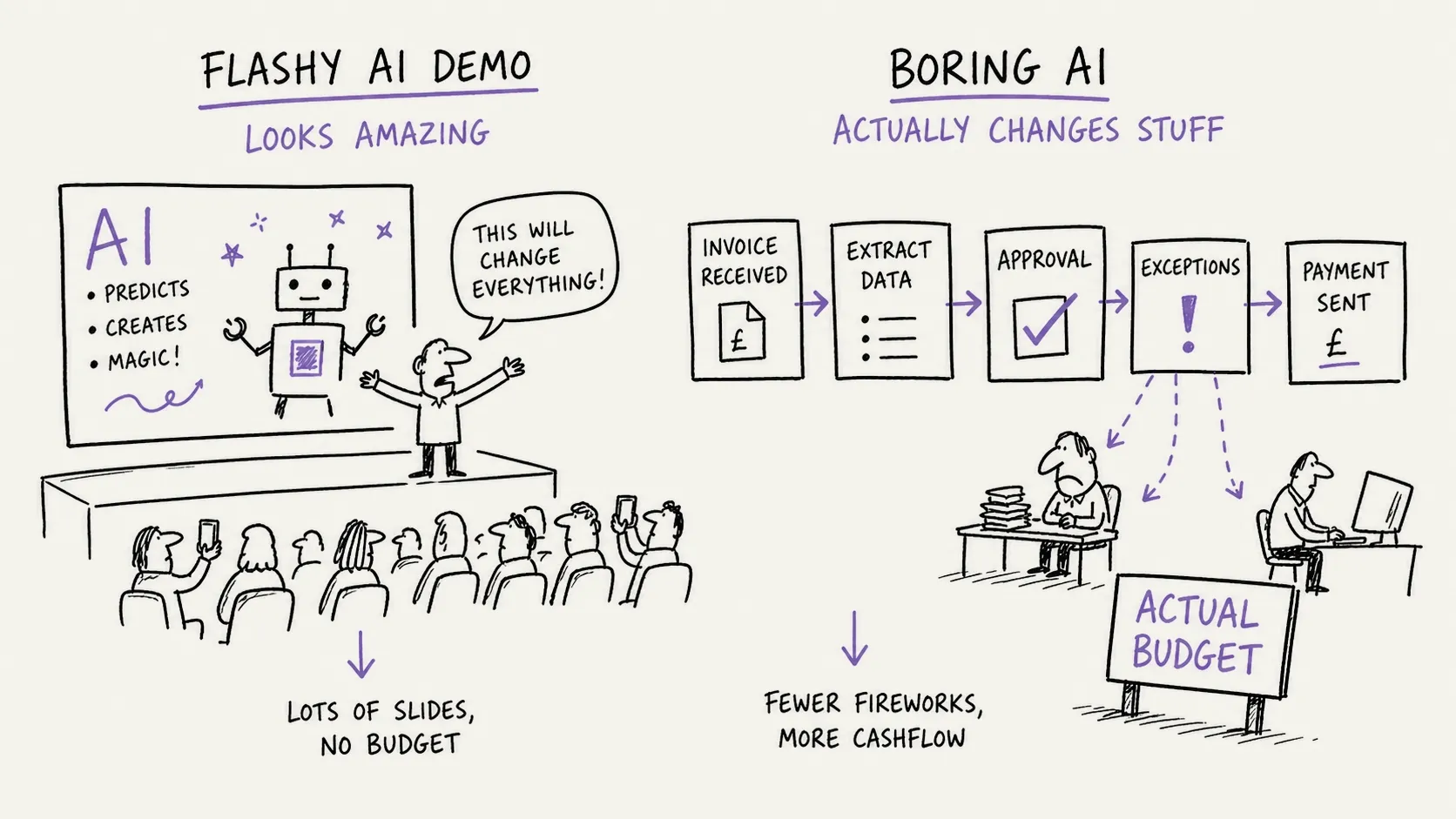
In document-heavy workflows such as invoices, claims, procurement, compliance or support, these small corrections are not trivial. They are the business teaching the system what "right" means.
That is where defensibility starts. Not because the AI was wrong, but because the product captured why.
Corrections are the business teaching the system what 'right' means.
UX Makes The Signal Usable
The correction experience has to be designed carefully. Ask for too much metadata and people will avoid it. Ask for too little and the correction cannot be reused. Make the user feel like a data-entry assistant and they will quite reasonably resent the whole bloody thing.
Good correction design is fast, explicit and proportionate.
The user should be able to fix the output quickly. The system should infer as much context as possible. Where extra meaning is needed, the product should ask a small, useful question: is this a one-off change, a reusable rule, a missing source, or a policy issue?
The aim is not to turn every user into a machine-learning engineer. The aim is to capture just enough structure to make future work better.
The real AI moat is not the error. It is what the product does after the error.
The Moat Is What Happens Next
Correction data can improve several layers of an AI product.
It can sharpen prompts. It can improve retrieval. It can create rule checks. It can build evaluation sets. It can identify where a specialist model may eventually help. It can reveal workflow problems that AI alone cannot fix.
Most importantly, it creates customer-specific operational memory.
A competitor can access the same foundation model. They can copy the visible interface. They cannot easily copy months of real corrections, approval patterns, exception handling, policy nuance and evaluation data from inside a business workflow.
That is why the correction moment matters.
Design the Correction Taxonomy
- 01List the correction types that matter in your workflow
- 02Common types: factual, classification, policy, routing, missing evidence, approval
- 03Decide which corrections affect: rules, retrieval, evaluation, prompts, workflow logic
- 04Make correction fast enough that users will actually do it
- 05Store corrections in a form that improves future performance