Key takeaways in 3 minutes
The best AI opportunities are often not glamorous. They sit in the workflows nobody puts in a keynote: invoices, procurement exceptions, claims, compliance checks, support QA, document operations and internal admin.
That is where the commercial value is easier to prove. The work is repeated, the inputs are messy, the decisions matter, errors cost money, and improvement can be measured.
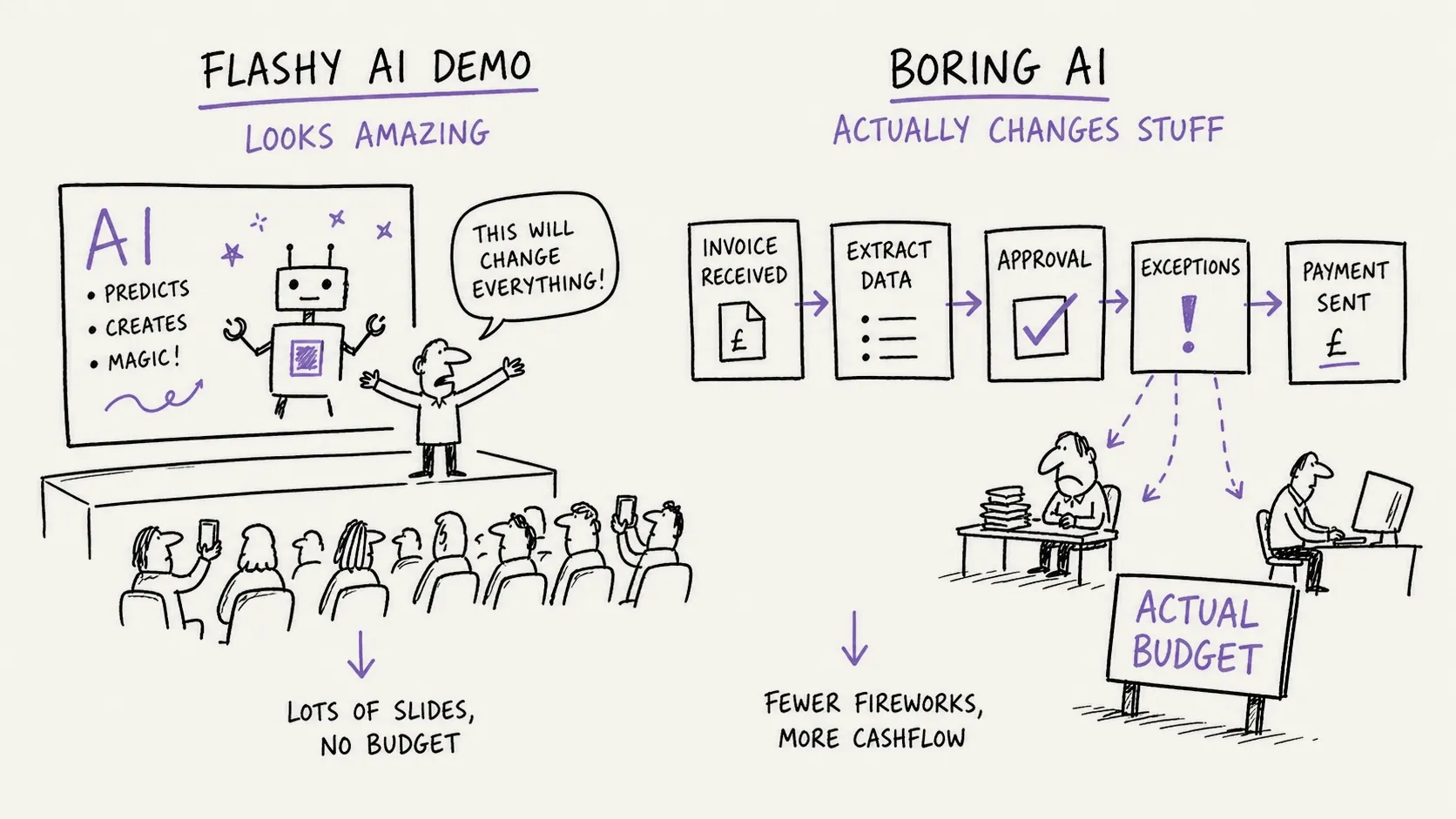
Flashy AI gets attention. Boring AI gets budget. Follow the friction, not the hype.
The trick is to stop asking "where can we add AI?" and start asking "where does this organisation repeatedly turn messy information into structured judgement?"
The serious money in AI may not be hiding inside the shiniest product. It may be sitting in the spreadsheet nobody wants to open, the invoice queue nobody quite owns, the procurement exception that delays a supplier payment, or the compliance check that still depends on someone reading three documents and hoping they have enough coffee.
That sounds less exciting than an AI companion with a velvet launch video. Fair enough. But businesses do not usually pay serious money because something feels futuristic. They pay when a system saves time, reduces risk, improves cash flow, prevents mistakes, or helps work move through the organisation faster.
The future arrived, and it wants to reconcile supplier records. Not glamorous, perhaps, but quite possibly where the budget is.
Flashy AI Gets Attention
Public AI conversation naturally gravitates towards visible demos. A tool writes copy, generates an image, builds a presentation, chats like a helpful colleague, or turns a rough prompt into a prototype. These are useful. They are also easy to understand quickly, which makes them perfect for LinkedIn, conferences and excitable product pages.
But visibility is not the same as value.
A flashy demo can show capability without proving commercial importance. It can impress a room without changing a process. It can make people say "wow" without making anyone say "we need to buy this before quarter end."
Visibility is not the same as value.
That distinction matters. Big businesses have plenty of interesting tools already. What they do not have is infinite patience for software that adds another surface without improving the work underneath.
Boring Workflows Get Budget
The best AI opportunities often live in operational workflows that are frequent, costly, rule-bound and measurable. Invoice processing. Procurement. Claims. Compliance. Logistics. HR administration. Support quality assurance. Document operations. Internal knowledge work.
These are not usually the workflows that make a keynote audience gasp. They are the workflows where delays cost money, errors create risk, and manual effort quietly eats margin every week.
What Makes A Boring AI Opportunity Valuable
Not every dull workflow is a good AI opportunity. The valuable ones usually share five traits.
The 5 Traits of a Valuable Boring AI Opportunity
- 01The work is repeated often enough to matter — hundreds or thousands of times a month
- 02The input is messy — emails, PDFs, spreadsheets, tickets, scanned records
- 03There is a meaningful decision — classify, route, match, approve, check, extract
- 04There is a correction loop — humans fix, explain, approve or flag when wrong
- 05The output lands somewhere useful — a validated record, an audit trail, a routed case
The correction loop is the most important. Those corrections are gold dust if the product captures them properly. They reveal business rules, edge cases, preferences and domain judgement.
The UX Opportunity
This is also where UX and product strategy become more valuable, not less.
Finding these opportunities requires more than asking "where can we add AI?" That question is too broad and, frankly, a bit lazy. The better question is: where does the organisation repeatedly turn messy information into structured judgement?
UX research is good at finding that. It exposes the work behind the screen: the copied notes, the shadow spreadsheets, the informal rules, the approval rituals, the exceptions, the fear of getting it wrong, and the small acts of human judgement that never appear in a process diagram.
The value is not just in the model. It is in the workflow around the model.
The Practical Move
Run a boring-workflow scan before chasing the exciting idea. Choose a department — finance, procurement, compliance, HR, support or operations. List the repeated workflows and score each one for frequency, cost, risk, data messiness, decision value and ease of validation.
Then choose one workflow and sketch the AI-assisted version. Not as a magic button. As a real operating model: input, interpretation, recommendation, human review, correction, validation and system of record.
That is where credible AI strategy starts to look different from AI theatre.
The most valuable AI product may not be the one people clap for. It may be the one that quietly removes three hours of manual checking, prevents a costly mistake, shortens a process, and gives a business leader a number they can defend.
Follow the friction, not the hype. The boring stuff is often where the money is.