Key takeaways in 3 minutes
AI wrappers are useful, but many are fragile. If the product is only a nice interface over a general model, it can be copied, absorbed by a platform, or squeezed when model providers ship the same capability.
The wrapper is dead as a strategy. Long live workflow AI.
The easiest AI product to build is often the easiest one to copy.
The easiest AI product to build is often the easiest one to copy.
That is the uncomfortable truth behind a lot of AI product work. A wrapper can be useful. It can demonstrate a capability, create a nicer interaction, focus a model on a particular task, and help people understand what is possible. Wrappers are not automatically silly.
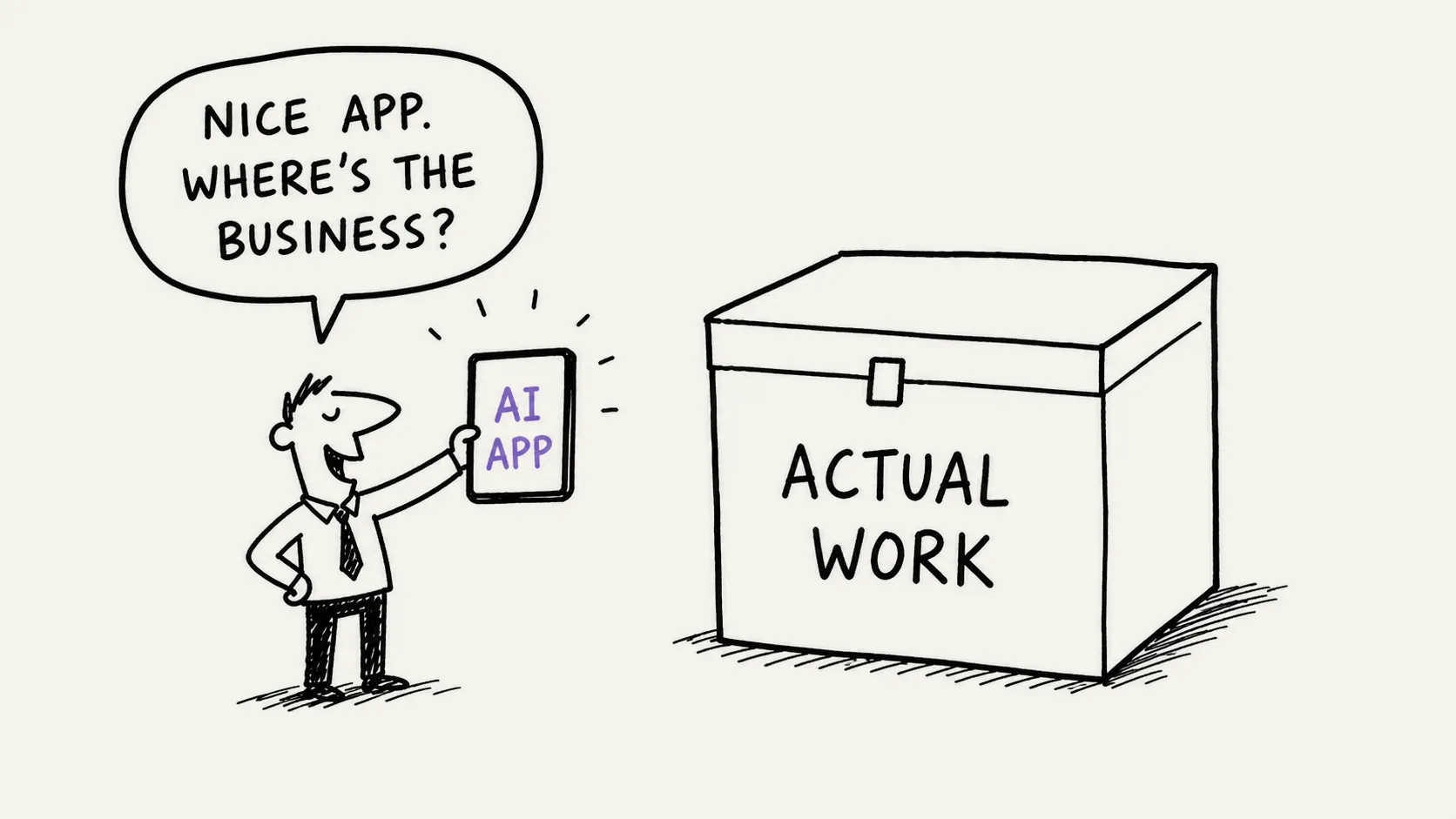
But if the product is only a prettier surface over broadly available model capability, the strategic ground underneath it can be thin. You may have built something that works, but not something that becomes stronger when real customers use it.
If the whole business disappears when OpenAI, Microsoft, Google or Salesforce adds the feature to a menu, the problem was not the colour of the button. The problem was that the product never owned enough of the work.
Why Wrappers Were Tempting
Wrappers were a natural first wave. Model capability arrived quickly, and people needed ways to apply it. A clean interface around summarisation, drafting, search, extraction or chat could create immediate value.
There is nothing wrong with that. In fact, wrappers helped many teams learn faster than any strategy deck could. They made AI tangible. They turned abstract capability into something people could try.
The trap is assuming that a useful wrapper is automatically a durable product.
When the model provider improves, the wrapper can get squeezed. When a platform adds a similar feature, distribution gets harder. When competitors copy the interaction, the advantage fades. The product may still survive, but only if there is something more valuable behind the interface.
That "something" is usually workflow.
What Workflow AI Means
Workflow AI is not just AI inside an app. It is AI embedded into a valuable business process.
It understands what happens before the AI interaction and what must happen after it. It knows what information starts the work, what decision needs to be made, who is accountable, what rules apply, what evidence is required, and where the final output needs to go.
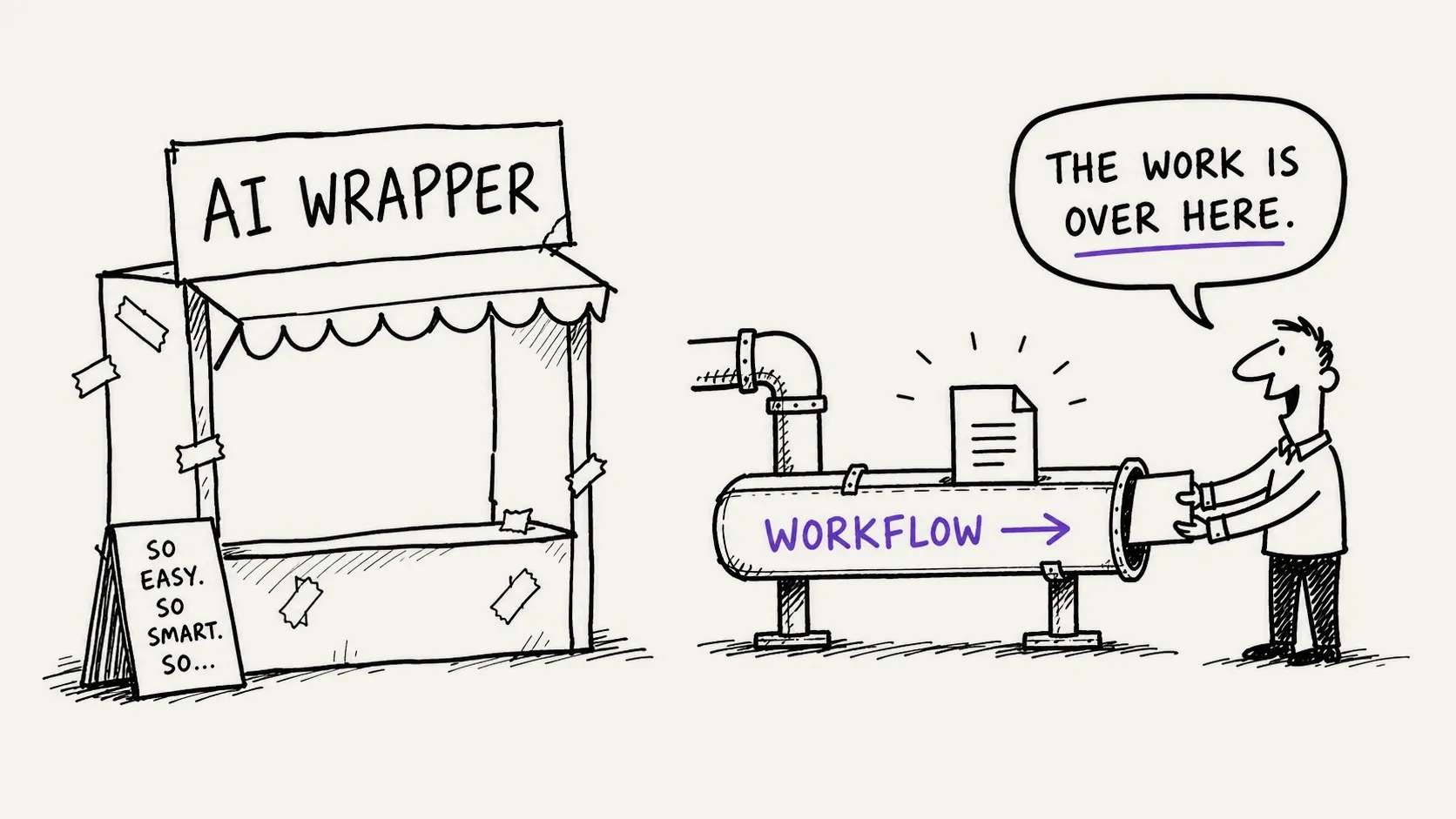
For example, a wrapper might summarise a supplier contract. Useful. A workflow AI system might extract obligations, compare them against policy, flag risky clauses, route exceptions to legal, capture human corrections, update the contract record and improve the next review.
That is a different thing.
The first is an interaction. The second is an operating model.
A new competitor can copy a screen. It is much harder to copy six months of corrections, integrations and trusted workflow behaviour.
Why Workflow AI Is Harder To Copy
Workflow AI is harder to copy because the value does not sit in one visible layer.
It sits in domain context: the messy, specific knowledge of how work actually happens. It sits in integrations with the tools where the organisation already runs. It sits in permission models, audit trails, review flows and exception handling.
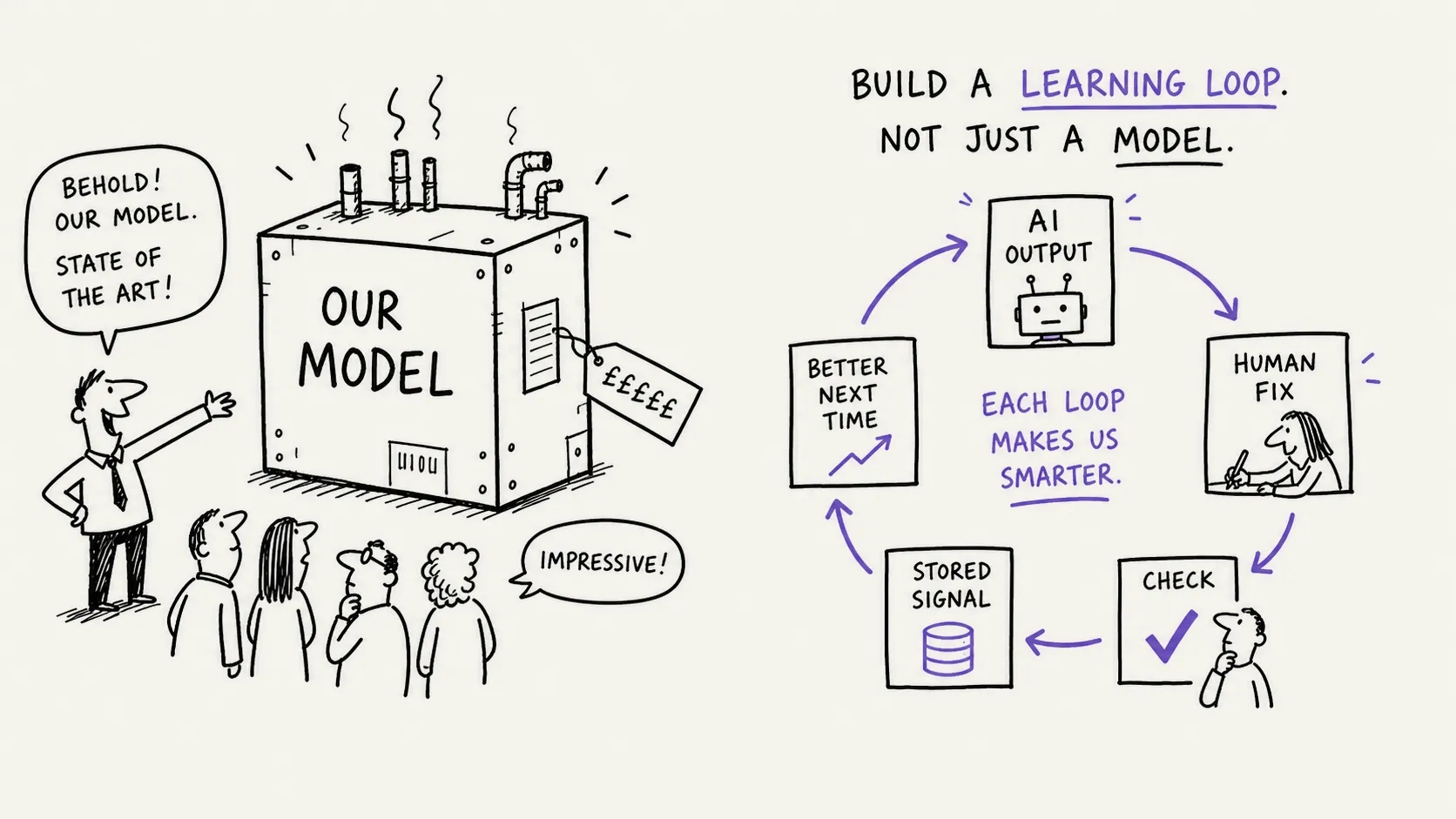
It also sits in feedback. When users approve, reject or correct AI output, they reveal what the system needs to know. They expose business rules, edge cases, language preferences, policy constraints and judgement calls. If the product captures those signals, it becomes better through use.
That is where defensibility starts to appear. Not because the model is magically unique, but because the product accumulates operational memory.
A new competitor can copy a screen. It is much harder to copy six months of corrections, integrations, customer-specific rules, evaluation data and trusted workflow behaviour.
The UX Shift
This is why UX strategy becomes more important in AI product work.
The designer's job is no longer just to design the moment where AI appears on screen. It is to understand the work around that moment: the inputs, handoffs, exceptions, approvals, failures, corrections and business consequences.
That means asking better questions.
What decision is the user trying to make? What evidence would make them trust the recommendation? What happens when the system is wrong? What should a human approve? Which corrections are one-off edits and which should become reusable learning? Where does the output need to land for value to be realised?
This is not decorative UX. It is product architecture with a human face.
The interface still matters, of course. Poorly designed workflow AI will fail because people will not understand it, trust it or fit it into their day. But the interface is only one layer of the system.
The wrapper is dead as a strategy. Long live workflow AI.
A Wrapper Versus Workflow Test
Here is a simple test. Take an AI product idea and ask what becomes more valuable after 100 real workflows have passed through it.
- Does it learn from corrections?
- Does it build customer-specific context?
- Does it improve a repeated decision?
- Does it connect to a system of record?
- Does it create an audit trail?
- Does it reduce measurable cost, delay or risk?
- Does it become harder to remove over time?
If the answer is yes, you may be moving towards workflow AI.
If the answer is no, and every interaction starts from scratch, you may only have a wrapper with a nice chair and a good haircut.
The Wrapper vs Workflow Test
- 01Map: input → model task → human review → correction signal
- 02Map: validation rule → approval step → system of record → measurable outcome
- 03Ask: what does the product learn after every use?
- 04If nothing accumulates, you may have a wrapper
- 05If knowledge, rules, trust and evaluation improve, you have workflow AI