Key takeaways in 3 minutes
Do not start AI strategy with "where can we add AI?" It is too broad, and it usually creates scattered ideas rather than useful decisions.
A useful AI strategy starts with better questions.
"Where should we use AI?" is too broad a question. It usually produces a brainstorm, a backlog, and a few ideas that sound impressive until someone asks who owns the data.
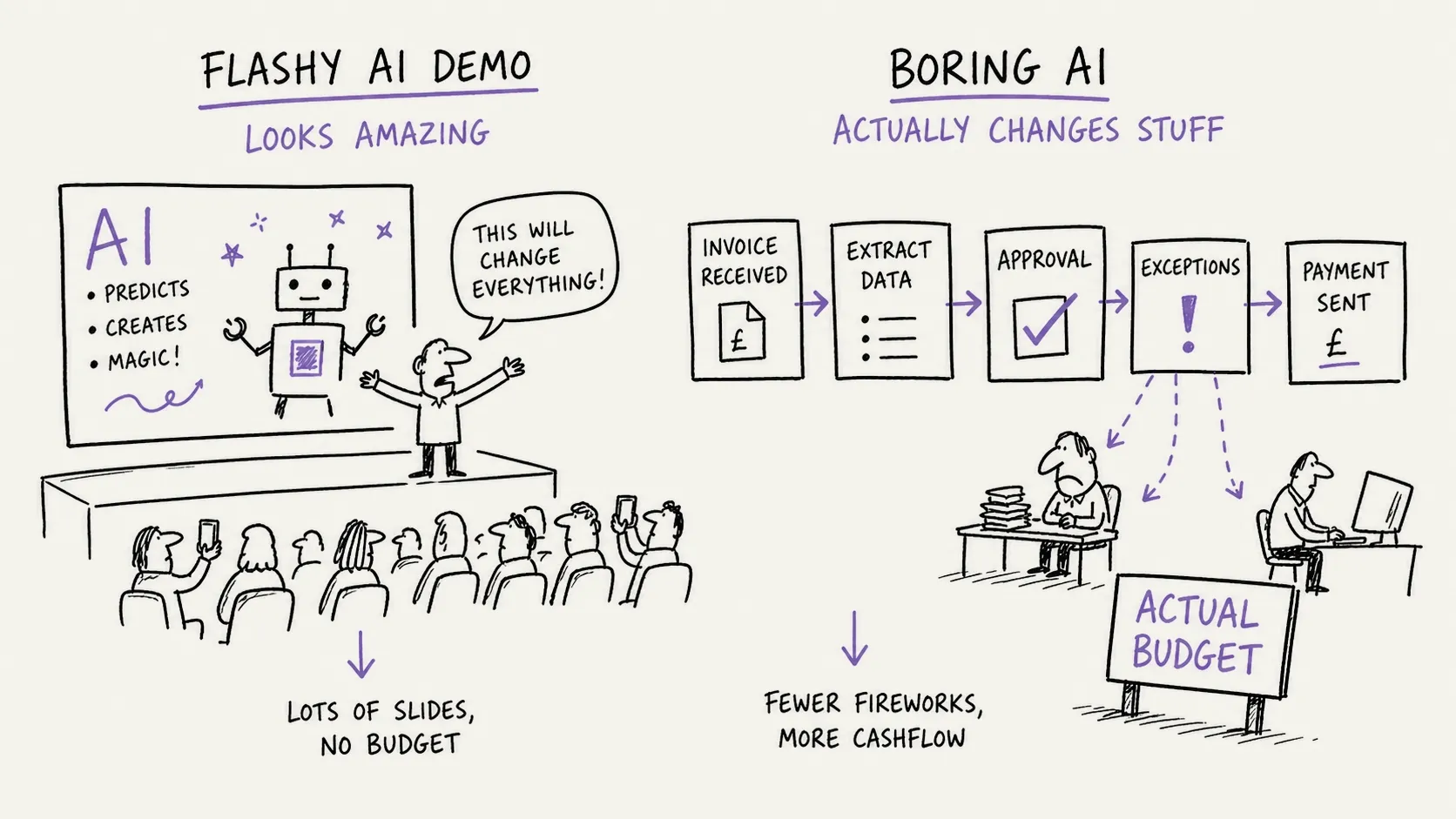
AI activity is not the same as AI strategy.
That is how organisations end up with AI activity but not necessarily AI strategy. A pilot here, a chatbot there, a promising demo in a deck, and somewhere a spreadsheet called AI ideas v7 final FINAL quietly gathering dust.
The better move is to audit AI opportunity.
Not because an audit sounds more serious, although it does have the pleasing smell of grown-up stationery. But because AI value is rarely found by guessing where a model might be interesting. It is found by looking for places where user pain, operational waste, repeated decisions, fragmented knowledge and measurable cost overlap.
Enthusiasm Is Not A Strategy
Most businesses are under pressure to respond to AI. That pressure is understandable. Competitors are experimenting. Vendors are promising transformation. Teams are asking what tools they should use. Leaders do not want to be late.
But urgency can make the question worse.
"Where can we add AI?" often leads teams towards visible features rather than valuable work. It encourages scattered experiments because almost anything can be made to sound like an AI use case if the room is tired enough.
An opportunity audit changes the conversation. It asks where AI could improve a decision, reduce waste, speed up a workflow, lower risk, or unlock value that is currently stuck in manual work.
That is a more useful starting point.
What To Audit
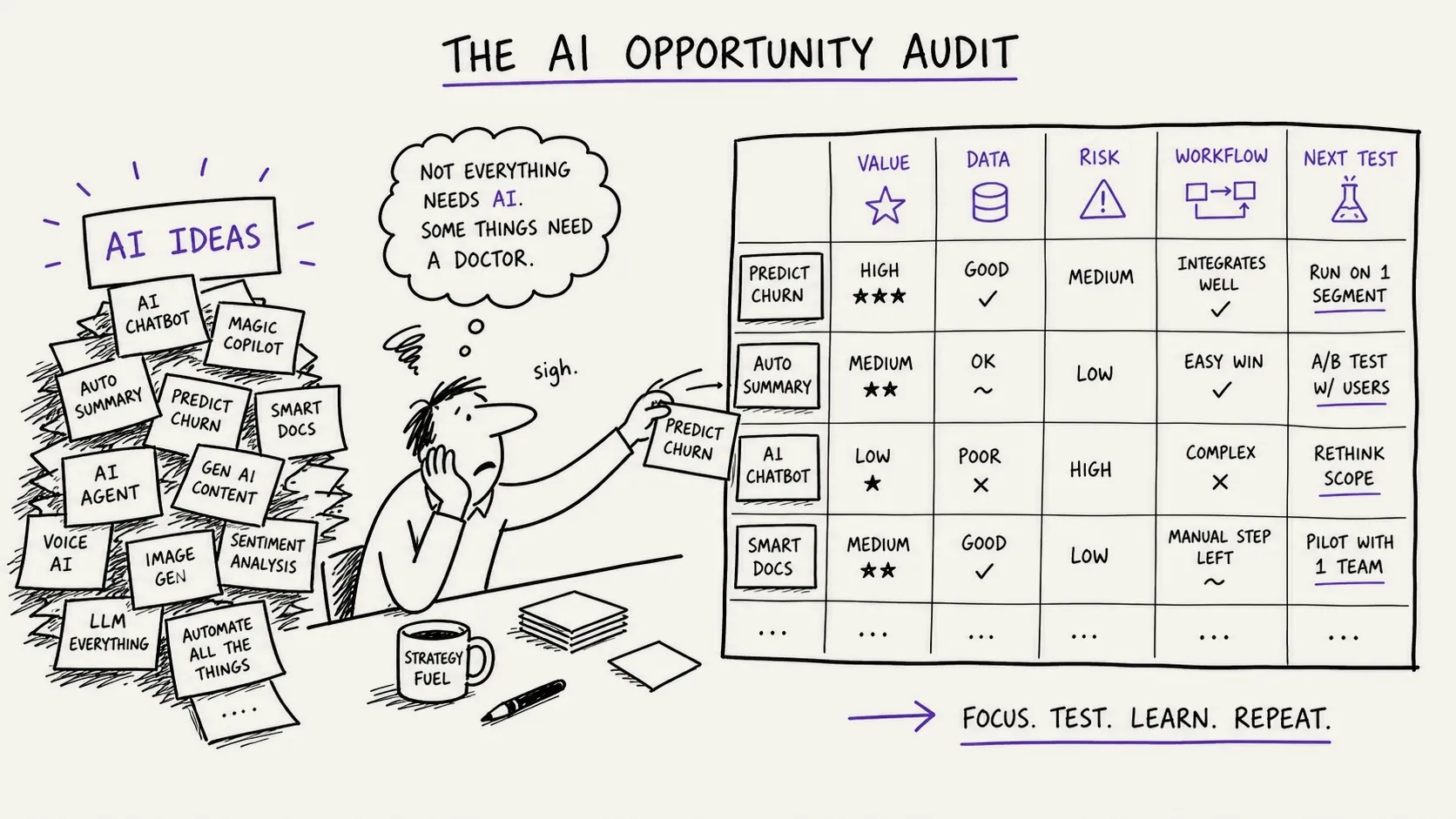
A good AI opportunity audit looks across six areas.
First, business value. What cost, delay, risk or opportunity is attached to the workflow? If nobody can explain why improvement matters, AI is probably not the missing ingredient.
Second, user value. Where are people stuck, repeating work, making awkward decisions, checking information or compensating for weak systems?
Third, workflow shape. Is the work repeated? Does it involve handoffs, approvals, exceptions, rules or operational consequences?
Fourth, data readiness. What information starts the work? Is it structured, messy, fragmented, reliable, sensitive, current, or hiding in seventeen systems with heroic levels of passive aggression?
Fifth, trust and risk. What happens if AI gets this wrong? Can the output be reviewed, validated, explained or constrained?
Sixth, feasibility. Can the team prototype a useful slice without rebuilding the entire business before lunch?
These dimensions stop AI strategy becoming a list of fashionable features. They turn it into a decision tool.
The goal is not to produce a giant AI roadmap. The goal is to stop guessing.
Why UX Strategy Belongs Here
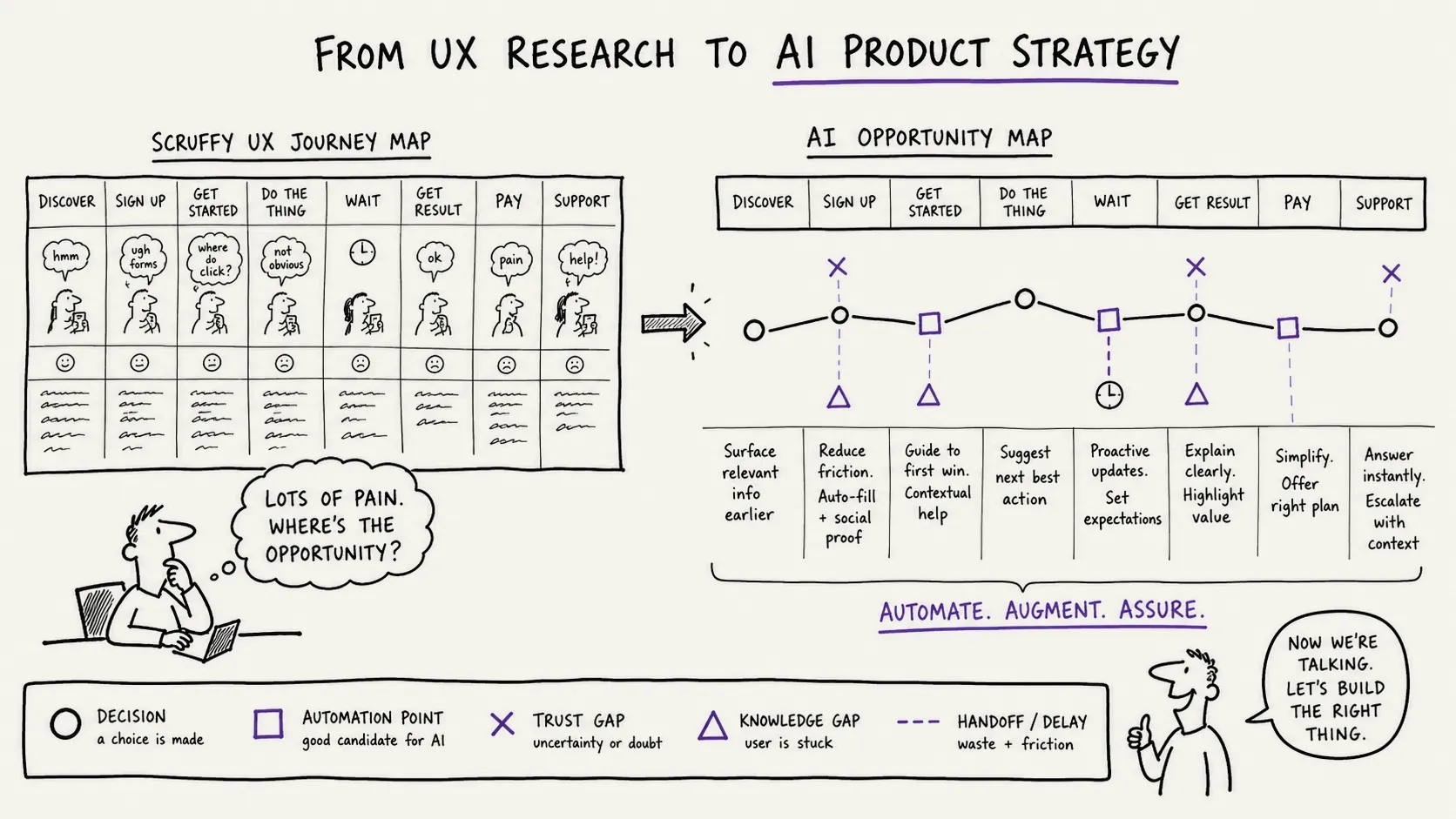
UX and service design are well suited to this work because they already examine journeys, systems, friction, behaviour, roles and context.
That matters because valuable AI opportunities rarely live in one neat screen. They live in the gap between tools. They hide inside approval steps, support workarounds, exception handling, repeated judgement calls and knowledge that experienced staff carry around in their heads.
The role of the AI Product Architect is to connect these dots: user pain, business value, workflow reality, data, trust and delivery risk.
That is not a traditional feature brainstorm. It is a structured way to decide where AI should be investigated, where it should be avoided, and where a small experiment could reduce uncertainty.
A useful AI strategy starts with better questions.
A Simple Audit Matrix
For each possible opportunity, score:
- Business value
- User value
- Frequency
- Workflow complexity
- Data readiness
- Trust and risk
- Feasibility
- Learning potential
- Integration need
Then add one plain-English recommendation: prototype, research further, park, or reject.
This matters because weak ideas often survive in vague language. They sound good until they are scored against reality. Strong ideas usually become clearer under pressure: the problem is frequent, the cost is visible, the decision is repeated, and the next experiment is obvious.
The AI Opportunity Audit
- 01Choose one product area or department
- 02Map the workflow and mark: repeated decisions, slow handoffs, manual checking, fragmented knowledge
- 03Flag trust-sensitive moments and expensive errors
- 04Score each opportunity: business value, user value, workflow fit, data readiness, trust risk, feasibility
- 05Choose one to prototype or research — reject or park the rest