Key takeaways in 3 minutes
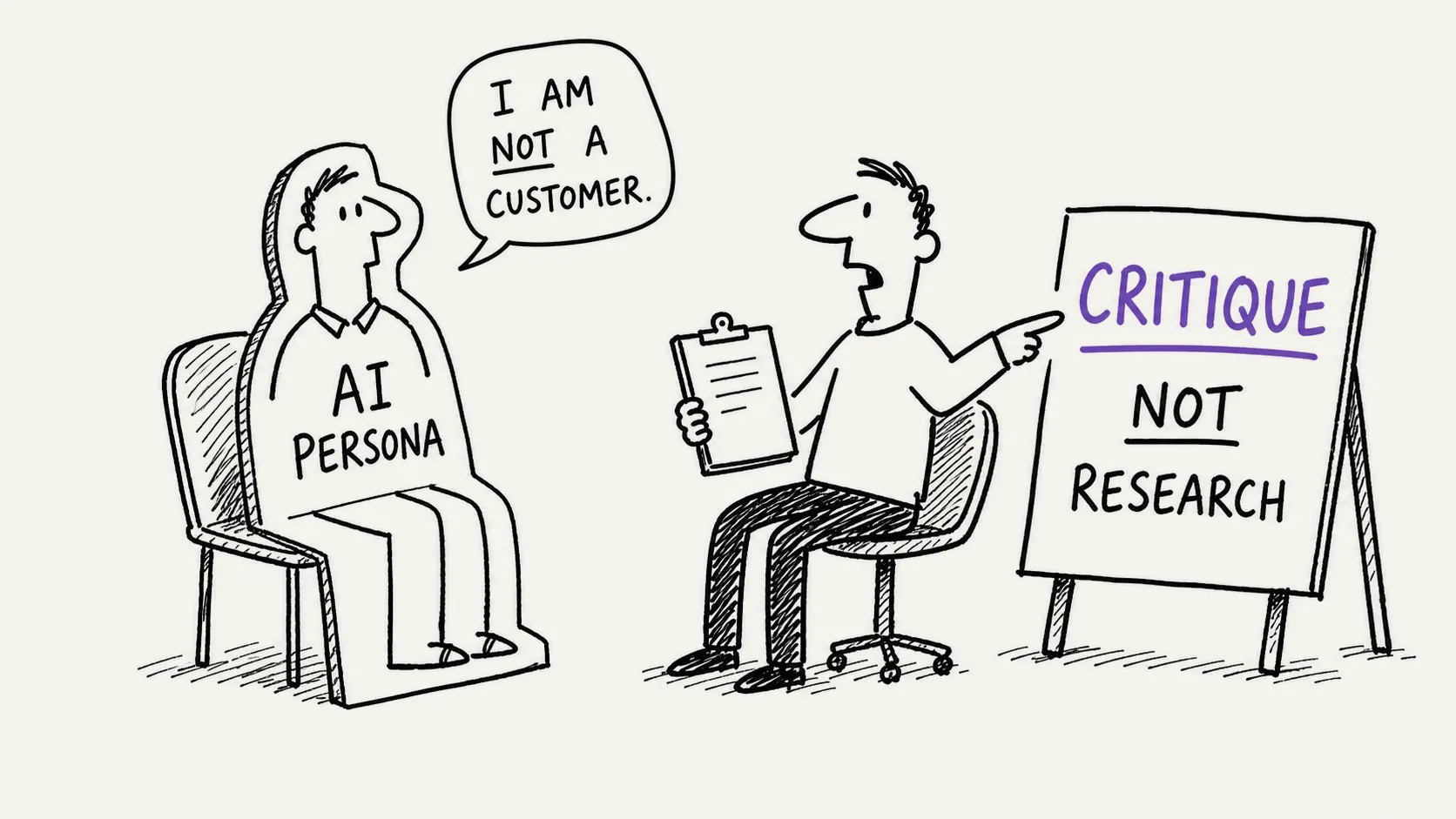
AI personas are not users. Do not treat them as research.
You are not looking for truth. You are looking for sharper questions.
AI personas are not your customers. That is precisely why they can be useful, as long as you stop pretending they are research and start using them as structured provocation.
The output is not truth. It is a list of objections, risks and questions.
The danger is not that AI personas are fake. The danger is forgetting they are fake because they sound confident in a blazer.
Used badly, synthetic personas create false certainty. A model produces neat feedback, the team mistakes it for evidence, and suddenly someone is saying "users told us" when no user has been anywhere near the conversation. That is not research. That is a cardboard cut-out with excellent posture.
Used honestly, though, AI personas can be a fast critique layer. They can expose assumptions, edge cases, adoption barriers and questions worth testing before the team spends serious time or money.
Critique, Not Evidence
The boundary matters.
AI personas cannot tell you what real customers need, feel, buy, trust or do. They cannot replace interviews, analytics, field research, usability testing or market evidence. They do not know your customer politics, procurement constraints, old habits, messy data or Monday morning mood.
But they can help you rehearse better.
Ask an AI persona to behave like a real customer and you invite nonsense. Ask it to critique from a bounded perspective and it becomes more useful. A cautious operations manager. A frustrated support lead. A procurement director under compliance pressure. A new user with low context. A competitor's strongest customer segment.
The output is not truth. It is a list of objections, risks and questions.
Where The Loop Helps
A rapid AI persona loop is useful early, when the cost of changing direction is still low.
You can use it to stress-test a proposition, competitor move, feature concept, onboarding flow, pricing message, internal tool or product strategy. The point is not to decide what customers want. The point is to improve the quality of what you ask next.
For example, you might present a competitor feature to three synthetic perspectives and ask: what seems valuable, what feels risky, what is unclear, what would stop adoption, and what proof would you need before trusting it?
Some output will be generic. Some will be wrong. Some may be annoyingly useful.
That is enough. The value is not "the AI said users want X." The value is "the AI exposed five questions we had not asked."
AI is not replacing research. It is speeding up the preparation around research.
A Practical Stress-Test Method
Keep the workflow simple.
- Define the product idea, proposition or competitor move.
- Create three bounded critique roles.
- Give each role a goal, constraint and likely objection.
- Ask for critique across value, clarity, risk, trust, adoption and missing evidence.
- Sort the output into useful, generic, wrong and validate.
- Turn the best points into real research questions or prototype changes.
That final sorting step is essential. Without it, you are just collecting confident paragraphs. With it, you are applying judgement.
This is where the AI Product Architect mindset matters. AI is not replacing research. It is speeding up the preparation around research.
You are not looking for truth. You are looking for sharper questions.
Boundaries To Say Out Loud
Stakeholder language matters here. Do not say "we tested this with AI users." That sounds efficient right up until someone sensible asks what an AI user had for breakfast.
Say this instead:
- We used AI to generate synthetic critique.
- This is not customer evidence.
- It helped us identify assumptions and questions.
- The next step is real validation.
That language builds trust because it is honest about what the method can and cannot do.
The AI Persona Stress-Test
- 01Pick three bounded critique roles (e.g. sceptical buyer, end user, ops manager)
- 02Ask each for: objections, adoption risks, trust concerns, missing evidence
- 03Sort every output into: useful, generic, wrong, or needs validation
- 04Use useful outputs to sharpen discovery questions
- 05Never present synthetic critique as customer evidence