TX-1 Terminal Explorer
TX-1 Terminal Explorer is a working prototype for agentic AI in enterprise supply chain modelling: it diagnoses optimisation failures, validates fixes in a dry run, and presents a human-approved action card before committing any change.
View live project ↗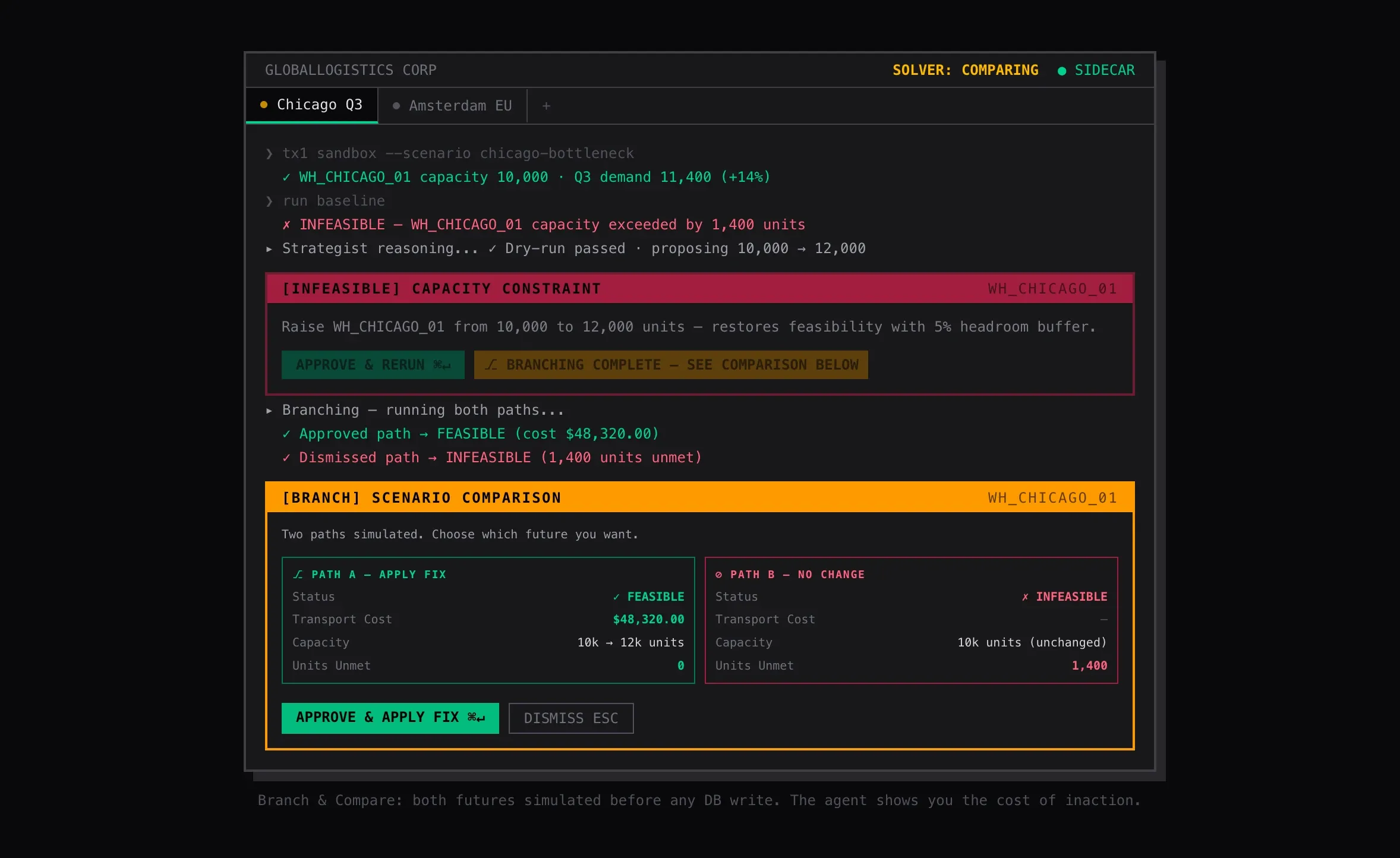
One-Line Summary
TX-1 Terminal Explorer is a working prototype for agentic AI in enterprise supply chain modelling: it diagnoses optimisation failures, validates fixes in a dry run, and presents a human-approved action card before committing any change.
Why This Project Exists
Enterprise AI is often stuck at the insight layer. It can summarise problems, surface anomalies and generate recommendations, but the human still has to do the recovery work across multiple systems.
TX-1 explores a more valuable pattern: AI that can close the operational loop while keeping the human in control.
The core question:
What if the AI handled the investigation and validation, while the human owned the decision?
The Problem
Supply chain optimisation workflows are sensitive to small data issues. A single bad capacity value, demand assumption or logistics lane can make a scenario infeasible.
When that happens, skilled planners spend time moving between systems, checking records, forming hypotheses, applying manual changes, rerunning the solver and documenting the outcome.
The cost is not just time. It is cognitive load, hidden decision-making and poor auditability.
The Product Response
TX-1 is designed as a keyboard-summoned terminal that connects a supply chain model, a solver, local data and a multi-agent backend.
When the solver fails, the system:
- Classifies the failure.
- Inspects the relevant schema and rows.
- Proposes a patch.
- Executes the patch inside a rolled-back transaction.
- Reruns the solver against the temporary state.
- Presents a validated action card to the user.
- Applies the fix only after explicit approval.
- Writes the decision to an audit trail.
Key Design Decisions
Terminal Over Dashboard
A dashboard would make the system feel like reporting software. TX-1 is closer to an operating surface. The terminal pattern supports command, sequence, legibility and direct action.
Approval As Architecture
The human-in-the-loop gate is built into the state machine. The agent cannot commit a patch without user approval. This makes uncontrolled action structurally impossible.
Dry Run Before Proposal
The system must prove that a proposed fix restores feasibility before it asks the user to approve it. This turns the action card from a suggestion into a validated decision point.
Action Cards As Decision UI
The action card shows the problem, proposed change, evidence, expected impact and approval controls in one place. The UI is shaped around a decision, not a notification.
Local-First Data Handling
The prototype is designed around local execution and minimum necessary data exposure. Sensitive operational data stays close to the system; the reasoning layer receives only the context it needs.
Architecture Snapshot
- Desktop shell: Tauri.
- Backend: Python FastAPI.
- Agent orchestration: LangGraph.
- Solver: Google OR-Tools.
- Persistence: SQLite.
- Reasoning layer: Claude.
- Interaction model: terminal stream plus structured action cards.
Agent Roles
- Dispatcher: classifies the failure or user intent.
- Inspector: identifies the relevant data and schema.
- Strategist: proposes and validates the fix.
- Archivist: retrieves similar historical fixes and context.
Each agent has a narrow responsibility so the system remains explainable, testable and easier to debug.
What This Demonstrates
TX-1 demonstrates AI product architecture rather than only UI design.
It shows:
- Workflow AI rather than a chatbot wrapper.
- Human approval as a product feature.
- Dry-run validation as a trust mechanism.
- Agentic reasoning with bounded responsibilities.
- Auditability designed into the workflow.
- A serious enterprise interaction model for AI-assisted action.
What It Does Not Claim
TX-1 is not a production-ready supply chain product. The scenario is synthetic and deliberately constrained.
The project is a proof of concept for a reusable pattern: validated AI action with human ownership.
Why It Matters
The pattern applies beyond supply chain.
Any high-accountability workflow with messy data, repeated failures, proposed fixes, human sign-off and system-of-record updates could use this architecture.
Examples include finance controls, compliance exceptions, data quality remediation, operational planning and regulated decision support.
Portfolio Value
TX-1 positions the work as AI/UX product architecture:
- It starts from a real operational problem.
- It connects workflow, trust, interface and architecture.
- It demonstrates agentic system design.
- It shows how UX thinking moves upstream into operating-model design.