Swarm Lite
Swarm Lite is a full-stack AI product strategy prototype that lets teams define a market, generate representative AI personas, run structured huddle sessions and turn multi-perspective feedback into decision-ready strategy briefs.
View live project ↗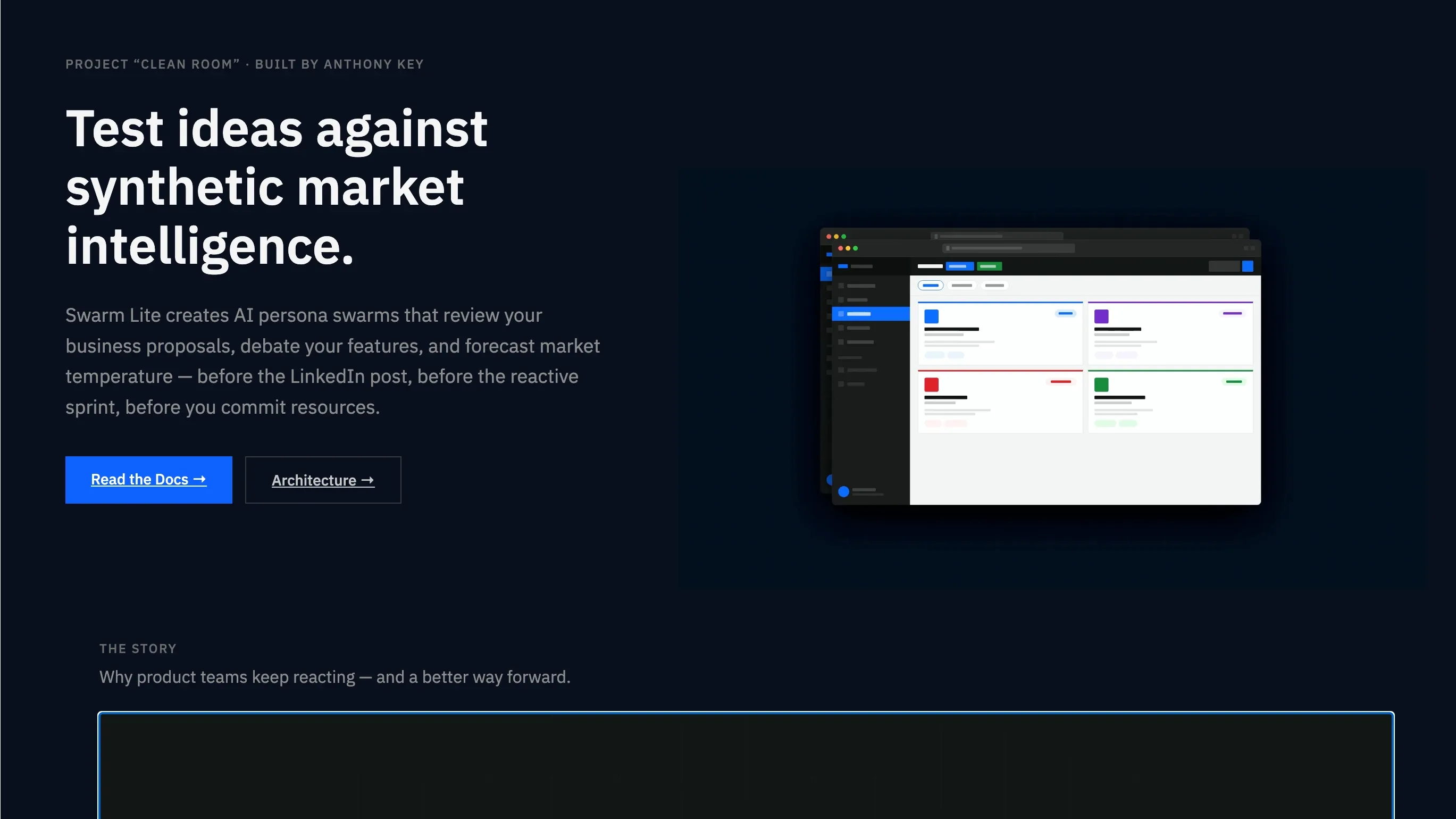
One-Line Summary
Swarm Lite is a full-stack AI product strategy prototype that lets teams define a market, generate representative AI personas, run structured huddle sessions and turn multi-perspective feedback into decision-ready strategy briefs.
Why This Project Exists
Product teams often react to market signals before they have enough structured context to reason well.
Swarm Lite explores how AI can create a fast, useful first-pass feedback layer: not replacing research, but helping teams challenge assumptions before they commit roadmap time.
The core question:
What if teams could test strategic thinking against representative market perspectives before the sprint begins?
The Problem
Competitive screenshots, stakeholder pressure and market anxiety can turn quickly into backlog work.
Teams may have plenty of information, but that information is often scattered across Slack, Notion, memory, research notes and stale strategy documents.
The missing capability is structured, queryable market perspective at the moment a strategic question appears.
The Product Response
Swarm Lite lets a user:
- Define a market with description, competitors and signals.
- Generate AI personas aligned to that market.
- Run huddle sessions where each persona responds independently.
- Review alignment scores, sentiment, themes and recommended actions.
- Branch sessions to explore follow-up questions.
- Export the resulting strategy brief.
- Route consequential actions through human approval.
Key Design Decisions
Personas As Strategy Prompts
The personas are not treated as research truth. They are designed to challenge assumptions, surface missing perspectives and help product teams think before they commit.
Briefs Over Chat Logs
The output is a structured strategy brief rather than a conversation transcript. This makes the result easier to share, compare, archive and act on.
Branching As First-Class Strategy
Strategic reasoning is not linear. Swarm Lite allows users to branch a session, adjust the question or persona mix, and explore a thread without losing the original context.
Human Approval For Consequential Actions
Recommended actions that require real resources move through an approval gate. The human sees cost, context and rationale before deciding. Every decision is logged.
IBM Carbon For Enterprise Trust
The interface uses IBM Carbon to signal enterprise credibility, accessibility and procurement-friendly design discipline. The design choice supports trust rather than novelty.
LangGraph For Agent Orchestration
The reasoning workflow uses graph-based orchestration so the system can branch, inspect state and handle multi-step reasoning more reliably than a simple linear chain.
Architecture Snapshot
- Frontend: Next.js 16 and React 19.
- Backend: Python FastAPI.
- Agent orchestration: LangGraph.
- Reasoning layer: Anthropic Claude.
- Persistence: SQLite.
- Design system: IBM Carbon.
- Presentation layer: marketing website with rendered walkthrough assets.
Core Workflow
- Define a market.
- Generate personas.
- Ask a strategic question.
- Run independent persona responses.
- Produce sentiment, themes and alignment score.
- Generate recommended actions.
- Branch the session if needed.
- Route consequential actions to human approval.
- Log the decision.
What This Demonstrates
Swarm Lite demonstrates AI/UX product architecture for decision support.
It shows:
- Strategic framing before feature design.
- AI personas used responsibly as assumption challengers.
- Structured artefact generation instead of raw chat.
- Branching interaction design for product thinking.
- Human-in-the-loop approval as enterprise architecture.
- Enterprise design-system judgement.
- A reusable AI feedback chassis beyond one domain.
What It Does Not Claim
Swarm Lite does not claim AI personas are a replacement for real customers, research interviews or market validation.
The prototype is a first-pass intelligence and assumption-testing layer. Its value is in helping teams ask better questions earlier.
Why It Matters
The architecture can apply beyond product strategy.
Examples include:
- Healthcare service design.
- Financial product positioning.
- Education curriculum planning.
- Government service policy.
- Enterprise sales messaging.
- Founder market validation.
The common pattern is structured feedback from representative archetypes before committing resources.
Connection To TX-1 And SS-1
Swarm Lite completes a useful trilogy:
- TX-1: internal operational failure to validated human-approved action.
- SS-1: external market signal to human-approved intelligence brief.
- Swarm Lite: strategic question to multi-perspective feedback and human-approved action.
All three share the same product philosophy:
- AI reasons against context.
- The output is a structured decision artefact.
- Humans own consequential decisions.
- The system logs what happened and why.
Portfolio Value
Swarm Lite positions the work as AI Product Architecture:
- It connects UX, strategy, AI orchestration and enterprise credibility.
- It shows how a single practitioner can use AI tooling to build polished, defensible product artefacts.
- It demonstrates judgement about what AI should and should not replace.
- It makes the user's strategic thinking visible through product decisions.