SS-1 Signal Shell
SS-1 Signal Shell is a market intelligence engine that turns competitor changes into structured strategy briefs, significance scores, proposed manifest updates and human-approved strategic records.
View live project ↗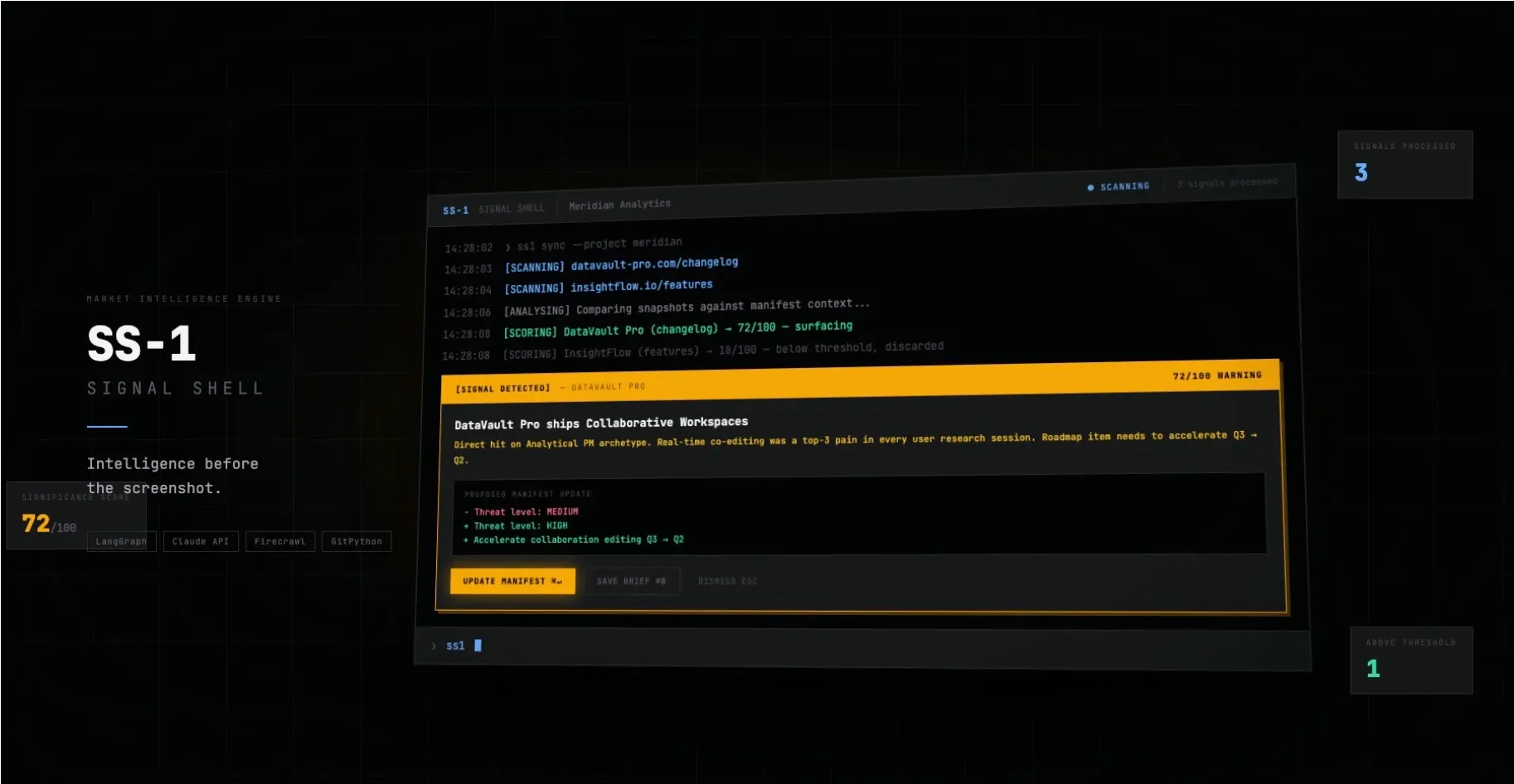
One-Line Summary
SS-1 Signal Shell is a market intelligence engine that turns competitor changes into structured strategy briefs, significance scores, proposed manifest updates and human-approved strategic records.
Why This Project Exists
Product teams do not usually lack competitor information. They lack a reliable way to turn raw signals into decisions.
SS-1 explores how AI can monitor the market, reason against a product's actual context, and bring decision-quality briefs to the people who own strategy.
The core question:
What if competitive intelligence produced decisions to consider, not alerts to chase?
The Problem
Competitor changes often enter product organisations as Slack screenshots, links, rumours or executive questions.
Without context, they quickly become reactive backlog items. Teams copy, chase or overcorrect before asking whether the change matters to their users or strategy.
The missing artefact is the brief: a structured interpretation of the signal in relation to the product's goals, priorities and user archetypes.
The Product Response
SS-1 monitors defined competitor sources and turns meaningful changes into structured briefs.
The system:
- Reads the project manifest.
- Monitors competitor URLs.
- Detects changes.
- Scores significance against the product context.
- Discards low-value signals.
- Generates a strategy brief for meaningful signals.
- Proposes a manifest update where appropriate.
- Requires human approval before the strategic record changes.
- Commits approved changes to git for auditability.
Key Design Decisions
Briefs Over Alerts
The product does not simply notify users that something changed. It explains why the change may matter, which assumptions it touches, and what response options are available.
Manifest Over Database
The product manifest is a markdown file under git version control. This makes the strategic context readable, editable, portable and auditable without special tooling.
Human Approval Over Autonomous Strategy
Agents can propose changes to the manifest, but they cannot apply them automatically. This keeps strategy owned by the human rather than slowly shaped by machine inference.
Significance Gate Over Signal Flood
Not every competitor movement deserves attention. The significance gate filters low-value changes before the user sees them.
Mock Data For Portfolio Integrity
The demo uses deterministic mock data so the product story is reliable. The point is to demonstrate the architecture and reasoning model, not to let a live scrape failure distract from the system design.
Architecture Snapshot
- Orchestration: LangGraph.
- Strategic context: markdown project manifest.
- Audit trail: git commits and diffs.
- Data source: deterministic mock OSINT layer in v1.
- Model assignment: lighter model for routing and scoring; stronger model for analysis and brief generation.
- Interaction model: command interface, structured briefs and approval flow.
Pipeline Nodes
- Monitor: collects competitor source changes.
- Analyst: compares current and previous source content.
- Significance Gate: scores the signal against product context.
- Propose: generates the brief and manifest update.
- Approve: waits for human decision before committing strategic change.
What This Demonstrates
SS-1 demonstrates AI product architecture for strategic work.
It shows:
- Context-aware AI rather than generic summarisation.
- Structured decision briefs instead of notifications.
- Human-owned strategy records.
- Git-backed strategic history.
- Significance filtering as a product feature.
- Clear separation between monitoring, analysis, scoring and proposal.
What It Does Not Claim
SS-1 is not claiming to be a complete enterprise competitive intelligence platform.
The v1 demo uses controlled data rather than live scraping. That is intentional. It keeps the portfolio demonstration focused on the product thinking, intelligence loop and architectural decisions.
Why It Matters
The pattern applies to product strategy, founder decision-making, market monitoring, sales enablement, account intelligence and any workflow where external change needs to be interpreted before a team acts.
The strategic value is not collection. It is contextual judgement.
Connection To TX-1
SS-1 is the external intelligence counterpart to TX-1.
TX-1 responds to internal operational changes. SS-1 responds to external market changes.
Both use the same product philosophy:
- Monitor for meaningful change.
- Reason against context.
- Present a structured decision.
- Require human approval.
- Record what changed and why.
Together, they demonstrate a reusable design language for enterprise AI systems with bounded autonomy and human accountability.
Portfolio Value
SS-1 positions the work as AI/UX product architecture:
- It starts from a real product organisation problem.
- It uses AI to improve decision quality, not just generate content.
- It treats strategic context as a first-class product object.
- It demonstrates agentic pipeline design.
- It shows mature judgement about trade-offs, reliability and portfolio presentation.